BATTLEFIED VISITS and TERRAIN WALKS
Historic Sites to Visit
Throughout the year, we take excursions to different historical sites in Belgium, France, and the Netherlands. You can also use this information to plan your own battlefield tours. All are accessible by train, bus, or car.
The Path of Peace - Walking the Western Front Way

Four and a half years of terrible trench warfare is the image most of us recall of World War I in Belgium and France. Barbara Tuchman, in her book The Guns of August, detailed the plans, generals, logistics, and battles of the first month of the war, when three German armies invaded neutral Belgium. By the end of the month, the Belgian Army stopped the Germans 20 km short of the coastal border with France. It did this by opening the flood dikes to fill the Yser River Valley with seawater in front of the German offensive.

Hiking or Biking the Western Front Way
Anthony Seldon shared his walk from Switzerland to the English Channel in his book The Western Front Way. The Western Front Way aims to provide a pilgrimage route of peace and contemplation for all people. There is no better way to understand the significance of trench warfare than to tour battlefields on foot or by bicycle. The trail is most developed in Belgium.
Ypres - Armistice Day Ceremony
We participate with the American Legion contingent during the annual 11/11 events in the Western Belgian town of Ypres. It is a hugely symbolic and restorative parade and ceremony at the Menin Gate memorial to the over 100,000 soldiers killed in action, but whose bodies were never identified.
We usually carry the flags of the three U.S. Army Divisions that fought near Ypres, under British command in Western Belgium. Those National Guard units were the 27th Infantry Division (New York), the 30th Infantry Division (South Carolina), and the 37th Infantry Division (Ohio) ("Buckeye"). See https://armyhistory.org/borrowed-soldiers-the-american-27th-and-30th-divisions-and-the-british-army-on-the-ypres-front-august-september-1918/

American Battle Monuments Commission
The ABMC has an excellent guide to their cemeteries, memorials, and where various US units fought in Belgium and France during WWI. The Guide is designed for car travelers. The American Expeditionary Force (AEF) consisted of three armies, nine corps, and 49 divisions. It was a force so huge the Germans could not continue the war even when the Russians dropped out of the war in early 1918.
Two US divisions fought in Belgium under French command. They included the 91st "Far West", and the 37th "Buckeye Infantry Divisions. They were, respectively, serving with the French VII Corps and XXX Corps, in the Army Group Flanders under His Majesty Albert I, the King of the Belgians.
Two other US Divisions fought in Belgium under British command. They included the 27th Infantry Division (NY) and the 30th Infantry Division (SC/NC/TN).
Battle of Mons - First major battle for British Expeditionary Force (BEF) - 23 August 1914
The French Army was about to be overwhelmed by a massive German force that had invaded neutral Belgium in order to turn the weak French left flank. A gap had opened after the Belgian Army was forced to withdraw into the National Redoubt in Antwerp. The French had not planned to cover the gap, preferring to concentrate their effort in the center of the German forces with the goal of reaching the Rhine.
The British Expeditionary Force moved from the reception ports to their assembly area in Maubeuge, France by 20 August 1914. Three days later, they engaged with the advance elements of the First German Army north of Mons. The first fight was between opposing forces on horseback at Casteau, the current location of Supreme Headquarters Allied Powers Europe (SHAPE). Most of the fighting was along the Nimy-Blaton-Péronnes Canal. After 2-3 days of intense combat, the BEF, consisting of two Corps, was forced to withdraw to the south under the pressure of the First German Army, which consisted of four Corps.
The Battle of Mons was the first major combat for the BEF. Every year the city of Mons celebrates the battle on 23 August. Mons provides a seven-hour WWI experience with a guide and coach. Or, if you like, you can walk or bike the battle sites using their excellent battlefield tour guide. An excellent map and guide are available. Search for it as: 985_guide_champs_bataille_lr.pdf.
Battles and Books participated with the Royal British Legion in the annual Battle of Mons ceremonies sponsored by the City of Mons. Very well done, and they had a bus take us to all the sites outside the city where battles were fought or where soldiers, both Allied and German, were buried.
Battle of Waterloo
The historic battle on 18 June 1815 proved to be Napoleon Bonaparte's last major offensive. It occurred just south of Brussels, in the Waterloo area. The excellent new museum, the battlefield terrain walks, and the annual reenactment of the battle provide an insightful, experiential understanding of the huge slugfest between the French and the Allied forces, comprising Dutch, British, and Prussian armies. See Waterloo Battlefield Map

Eben-Emael Fortress Visits
Eben-Emael was one of the fortresses built to defend Belgium and France from German invasion.

Eben-Emael was considered impregnable and the largest fortress complex in Europe before the German invasion of Belgium on 10 May 1940. The fortress was armed with long-range artillery meant to engage German forces crossing the border into Belgium from Aachen. The fort overlooks the confluence of the Meuse River, which flows north to Maastricht in the Netherlands, and the Albert Canal that allows barge traffic to continue west to the major port of Antwerp.

German glider troops, led by NCOs, took the fortress in less than 12 hours. Visitors can witness a reenactment of the battle to retake Eben-Emael by the 30th Infantry Division, U.S. Army National Guard, in September. See https://fort-eben-emael.be/en/

Main entrance into Fortress Eben-Emael

Eben-Emael Fortress sits on the high ground above the Meuse River and Albert Canal. Maastricht is to the north.

Ardennes Campaign - Battle of the Bulge
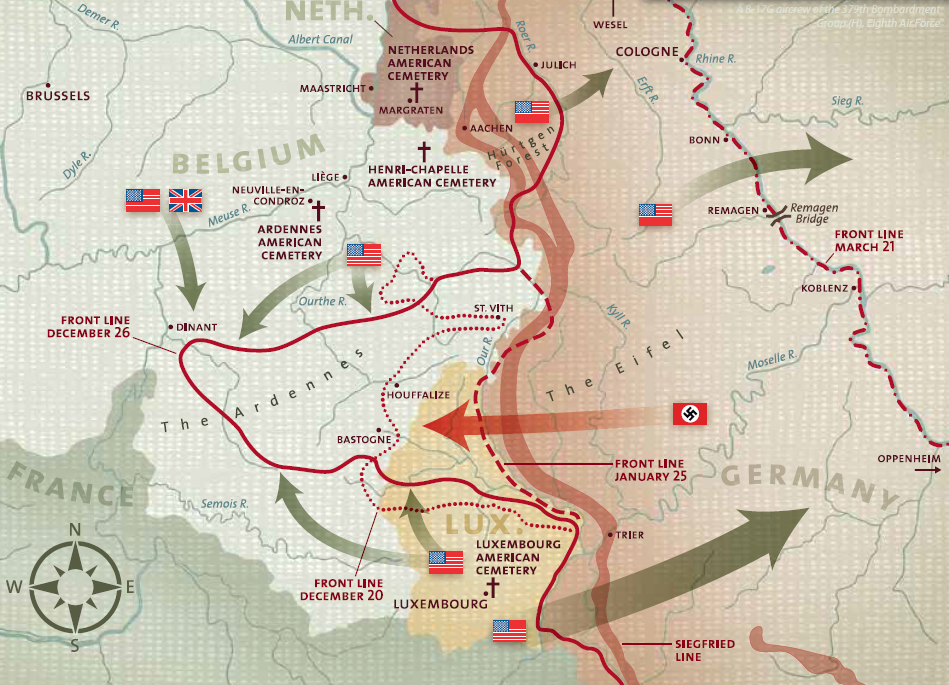
The Ardennes Campaign was a last-ditch effort to stave off the defeat of the Nazi regime. The German Army conducted a front-wide winter offensive against the weakest section of the American lines. It was part of a strategic attempt to break through the Allied front lines and strike deep into their rear area, with the critically important port of Antwerp, Belgium, as the target.
Along with numerous battlefield sites, this part of Belgium, Luxembourg, and the Netherlands is home to three major American military cemeteries, which we visit, especially on Memorial Day weekends in May.